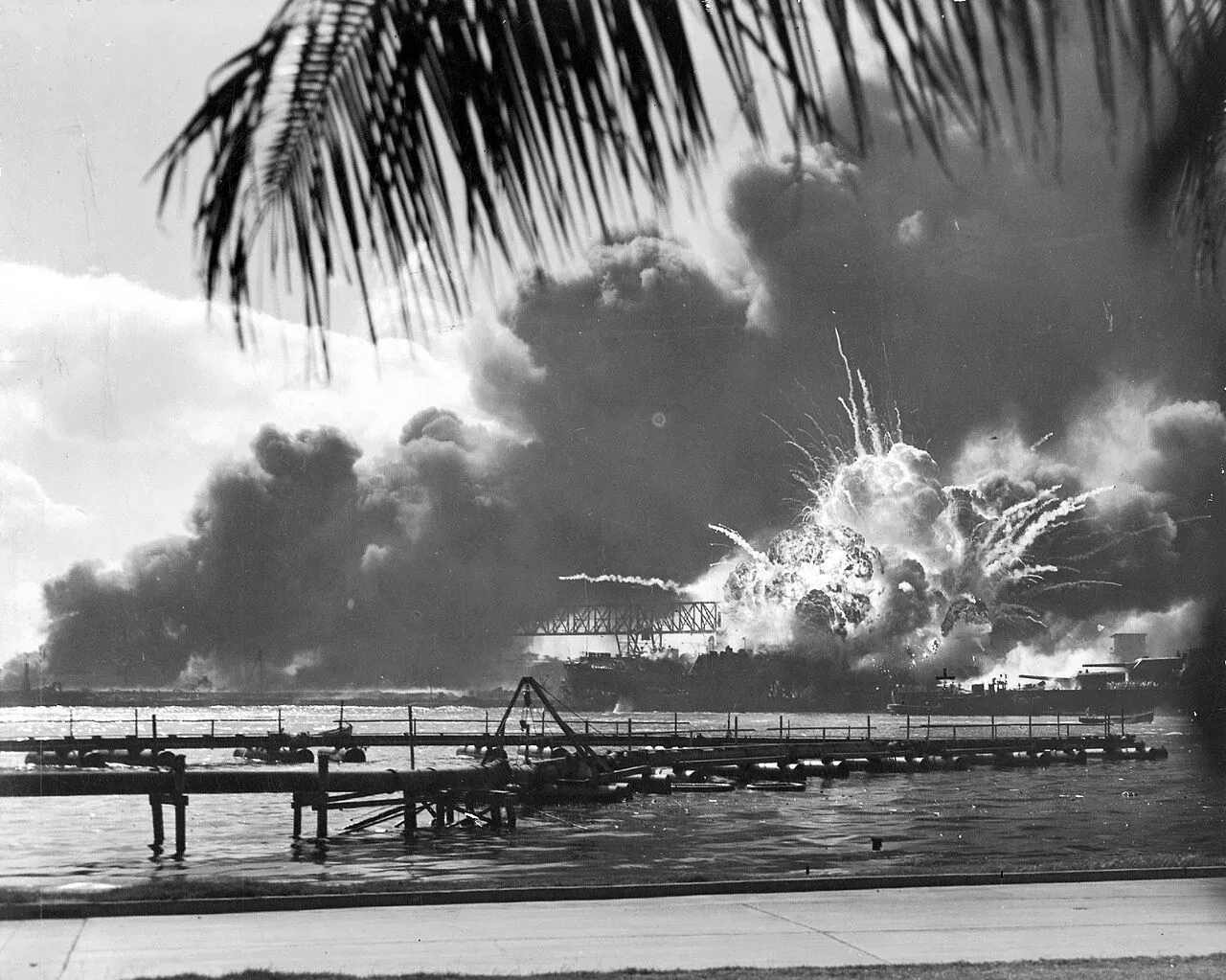
Two American veterans who survived the Japanese attack on Pearl Harbor in 1941 died last Saturday. Gebhard Galle was 105 and Freeman Johnson was 106. Galle died at his home in Moses Lake, Wash., his daughter Lynda Palmer said. Johnson died at his home in Centerville, Mass., his daughter Diane Johnson confirmed. They were among the last known survivors of the surprise assault that killed more than 2,400 Americans and brought the United States into the Second World War. The American Legion honoured the men in a social media post, calling them "two members of a generation whose courage and sacrifice will forever be part of our nation's history." Galle served on the battleship USS Nevada and Johnson was on the cruiser USS St. Louis during the attack. The number of known living Pearl Harbor veterans had been around a dozen since another survivor, Ira Schab, died in December 2025 at age 105.
Galle was below deck on the Nevada, waiting to go ashore for church, when he spotted aircraft through a porthole. A torpedo struck the ship, followed by bombs. The vessel began taking on water but managed to get underway before running aground after further attacks. "Of course, we felt a couple jolts, and that's when we got hit with the torpedo, and we had a few bomb hits," Galle told the Columbia Basin Herald in 2020. He said that after the ship beached, he went topside and saw the devastation, including the capsized USS Oklahoma.
Later in the war, Galle was on the USS Northampton when it was torpedoed by Japanese forces in November 1942. He was ordered to leave a hatch closed, trapping four sailors inside as the ship sank. Galle disobeyed and opened it, allowing the men to escape. "He heard those guys pounding on the roof of the hatch," Palmer said. "He went to open it up, and the senior officer walked by and said, 'No, leave it closed, because we don't want water to get in there because the ship might go down.'" Galle and others spent more than a day in life rafts before rescue.
A 2025 letter from then-acting Chief of Naval Operations Adm. James Kilby praised Galle's "courage under fire" during that incident and noted he fought in 19 major Pacific naval battles. Galle was born in Germany, moved to North Dakota as a child and enlisted in the navy at 18. After the war, he ran a refrigeration business, worked as a civil engineer for the air force and the Army Corps of Engineers, and retired in the 1980s.
Johnson was below deck working on a boiler aboard the St. Louis during the Pearl Harbor attack and did not witness it. "While all the rigamarole was going on topside, I was inside a steam drum. Couldn't see anything, absolutely nothing," Johnson told The Associated Press in a 2026 interview. His wartime service included helping to commission the battleship USS Iowa, which later transported President Franklin D. Roosevelt to a key conference in 1943.
Johnson witnessed the end of the war from the Iowa's mast on Sept. 2, 1945, as Japanese officials surrendered on the USS Missouri in Tokyo Bay. "I could see the boats coming up with the marines escorting the Japanese onto the ship and sitting around a table," he said. "It was all over." Johnson said the defining moments of his life were marrying his wife after the war and raising three daughters, not his military service. He worked in a machinist shop, a convenience store and delivered meals.